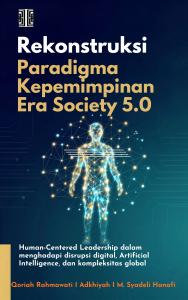
Rekonstruksi Paradigma Kepemimpinan Era Society 5.0: Human-Centered Leadership dalam Menghadapi Disrupsi Digital, Artificial Intelligence, dan Kompleksitas Global
Synopsis
Buku ini menguraikan perkembangan teori kepemimpinan mulai dari teori klasik, teori sifat, teori perilaku, teori situasional, kepemimpinan transformasional, hingga pendekatan kepemimpinan berbasis nilai dan manusia (human-centered leadership). Pembahasan dalam buku ini menjelaskan bahwa kepemimpinan tidak hanya berkaitan dengan kemampuan seorang pemimpin dalam memberikan arahan, tetapi juga mencakup kemampuan membangun hubungan, mengelola perubahan, mengembangkan potensi individu, serta menciptakan organisasi yang inovatif dan berkelanjutan. Selain membahas perkembangan paradigma kepemimpinan, buku ini juga membahas konsep Society 5.0 sebagai era masyarakat yang mengintegrasikan teknologi dengan kebutuhan manusia. Pemanfaatan teknologi seperti kecerdasan buatan (Artificial Intelligence), Internet of Things (IoT), big data, komputasi awan, dan robotika menjadi bagian penting dalam menciptakan masyarakat yang lebih cerdas, efektif, dan berkualitas. Namun, perkembangan teknologi tersebut juga menghadirkan berbagai tantangan, seperti kesenjangan digital, perubahan dunia kerja, keamanan data, serta persoalan etika dalam penggunaan teknologi. Dalam menghadapi era disrupsi digital, pemimpin dituntut memiliki kemampuan beradaptasi, literasi digital, kemampuan berpikir strategis, serta kemampuan membangun budaya organisasi yang inovatif dan kolaboratif. Pemimpin masa kini tidak hanya berperan sebagai pengambil keputusan, tetapi juga sebagai penggerak perubahan, fasilitator pengembangan sumber daya manusia, dan penjaga nilai-nilai kemanusiaan dalam organisasi. Buku ini menegaskan bahwa kepemimpinan di era Society 5.0 harus mampu mengintegrasikan perkembangan teknologi dengan nilai-nilai kemanusiaan. Kepemimpinan masa depan membutuhkan keseimbangan antara inovasi, integritas, empati, kolaborasi, dan keberlanjutan agar organisasi mampu menghadapi berbagai perubahan global. Buku ini menjadi referensi yang relevan bagi akademisi, mahasiswa, praktisi pendidikan, pemimpin organisasi, dan masyarakat umum yang ingin memahami perkembangan paradigma kepemimpinan serta membangun kepemimpinan yang adaptif, inovatif, dan berorientasi pada manusia di era digital.
References
Avolio, B. J., & Bass, B. M. (2004). Multifactor leadership questionnaire: Manual and sampler set. Mind Garden.
Bass, B. M. (1985). Leadership and performance beyond expectations. Free Press.
Bass, B. M., & Riggio, R. E. (2006). Transformational leadership (2nd ed.). Psychology Press.
Bennis, W. (2009). On becoming a leader. Basic Books.
Brynjolfsson, E., & McAfee, A. (2014). The second machine age: Work, progress, and prosperity in a time of brilliant technologies. W. W. Norton & Company.
Brynjolfsson, E., Rock, D., & Syverson, C. (2021). The productivity J-curve: How intangibles complement general purpose technologies. American Economic Journal: Macroeconomics, 13(1), 333–372.
Burns, J. M. (1978). Leadership. Harper & Row.
Castells, M. (2010). The rise of the network society: The information age: Economy, society, and culture (2nd ed.). Wiley-Blackwell.
Covey, S. R. (2004). The 7 habits of highly effective people. Free Press.
Davenport, T. H., & Kirby, J. (2016). Only humans need apply: Winners and losers in the age of smart machines. Harper Business.
Drucker, P. F. (2008). The essential Drucker: In one volume the best of sixty years of Peter Drucker’s essential writings on management. Harper Business.
Dweck, C. S. (2006). Mindset: The new psychology of success. Random House.
Edmondson, A. C. (2019). The fearless organization: Creating psychological safety in the workplace for learning, innovation, and growth. Wiley.
Goleman, D. (1995). Emotional intelligence: Why it can matter more than IQ. Bantam Books.
Goleman, D. (2006). Social intelligence: The new science of human relationships. Bantam Books.
Goleman, D., Boyatzis, R., & McKee, A. (2013). Primal leadership: Unleashing the power of emotional intelligence. Harvard Business Review Press.
Hamel, G., & Zanini, M. (2020). Humanocracy: Creating organizations as amazing as the people inside them. Harvard Business Review Press.
Heifetz, R. A., Grashow, A., & Linsky, M. (2009). The practice of adaptive leadership. Harvard Business Press.
Hofstede, G. (2001). Culture’s consequences: Comparing values, behaviors, institutions and organizations across nations (2nd ed.). Sage Publications.
Ismail, S., Malone, M. S., & van Geest, Y. (2014). Exponential organizations: Why new organizations are ten times better, faster, and cheaper. Diversion Books.
Japan Cabinet Office. (2019). Society 5.0: A human-centered society. Government of Japan.
Kaplan, A., & Haenlein, M. (2019). Siri, Siri in my hand: Who’s the fairest in the land? On the interpretations, illustrations, and implications of artificial intelligence. Business Horizons, 62(1), 15–25. https://doi.org/10.1016/j.bushor.2018.08.004
Kotter, J. P. (2012). Leading change. Harvard Business Review Press.
Licklider, J. C. R. (1960). Man-computer symbiosis. IRE Transactions on Human Factors in Electronics, HFE-1(1), 4–11. https://doi.org/10.1109/THFE2.1960.4503259
Maxwell, J. C. (2007). The 21 irrefutable laws of leadership: Follow them and people will follow you. Thomas Nelson.
McKinsey Global Institute. (2017). A future that works: Automation, employment, and productivity. McKinsey & Company.
Northouse, P. G. (2022). Leadership: Theory and practice (9th ed.). Sage Publications.
Organisation for Economic Co-operation and Development. (2019). OECD principles on artificial intelligence. OECD Publishing.
O’Reilly, C. A., & Tushman, M. L. (2016). Lead and disrupt: How to solve the innovator’s dilemma. Stanford University Press.
Pink, D. H. (2009). Drive: The surprising truth about what motivates us. Riverhead Books.
Porter, M. E., & Heppelmann, J. E. (2014). How smart, connected products are transforming competition. Harvard Business Review, 92(11), 64–88.
Prensky, M. (2001). Digital natives, digital immigrants. On the Horizon, 9(5), 1–6. https://doi.org/10.1108/10748120110424816
Rifkin, J. (2014). The zero marginal cost society: The internet of things, the collaborative commons, and the eclipse of capitalism. Palgrave Macmillan.
Rogers, E. M. (2003). Diffusion of innovations (5th ed.). Free Press.
Schwab, K. (2016). The fourth industrial revolution. World Economic Forum.
Schwab, K., & Davis, N. (2018). Shaping the fourth industrial revolution. World Economic Forum.
Senge, P. M. (2006). The fifth discipline: The art and practice of the learning organization. Doubleday.
Shneiderman, B. (2022). Human-centered AI. Oxford University Press.
Sinek, S. (2009). Start with why: How great leaders inspire everyone to take action. Portfolio.
Susskind, R., & Susskind, D. (2015). The future of the professions: How technology will transform the work of human experts. Oxford University Press.
Tapscott, D. (2014). The digital economy: Promise and peril in the age of networked intelligence. McGraw-Hill.
Tidd, J., & Bessant, J. (2020). Managing innovation: Integrating technological, market and organizational change (7th ed.). Wiley.
Toffler, A. (1980). The third wave. William Morrow.
Turban, E., Pollard, C., & Wood, G. (2018). Information technology for management: On-demand strategies for performance, growth and sustainability. Wiley.
UNESCO. (2021). AI and education: Guidance for policy-makers. UNESCO.
Uhl-Bien, M., Marion, R., & McKelvey, B. (2007). Complexity leadership theory: Shifting leadership from the industrial age to the knowledge era. The Leadership Quarterly, 18(4), 298–318. https://doi.org/10.1016/j.leaqua.2007.04.002
Van Wart, M. (2013). Administrative leadership theory: A reassessment after 10 years. Public Administration, 91(3), 521–543.
Westerman, G., Bonnet, D., & McAfee, A. (2014). Leading digital: Turning technology into business transformation. Harvard Business Review Press.
Wheatley, M. J. (2006). Leadership and the new science: Discovering order in a chaotic world. Berrett-Koehler Publishers.
World Economic Forum. (2023). The future of jobs report 2023. World Economic Forum.
Yukl, G. (2013). Leadership in organizations (8th ed.). Pearson.
Zohar, D. (2016). The quantum leader: A revolution in business thinking and practice. Prometheus Books.
Downloads
Published
July 2, 2026
Copyright (c) 2026 CV Cendekia Terpadu
Details about this monograph
ISBN-13 (15)
978-634-05-2395-9